
The Ficus Avenue

This collection highlights the legacy of the Garden's founder, Prof. Jacob Galil, and the remarkable reproductive biology of the genus Ficus.

Established at the Garden’s founding, this collection served as the primary site for Prof. Jacob Galil’s pioneering research into the specialized pollination systems of the Ficeae tribe. Today, several species thrive along the main path of Ficus Avenue. Visitors can find the Roxburgh Fig (Ficus auriculata) and the Sycamore Fig (Ficus sycomorus) to the west, while the Chinese Banyan (Ficus microcarpa) grows to the east.
These trees belong to the Moraceae (Mulberry) family, which includes the common fig (Ficus carica). The genus is defined by a unique inflorescence called a syconium. While it resembles a fruit, the syconium is actually a fleshy, hollow receptacle enclosing hundreds of tiny flowers. Pollination is carried out by specialized, microscopic wasps that enter through a narrow opening at the tip.
In many of these species, the syconia develop directly on the main trunk or older branches – a tropical adaptation known as cauliflory.
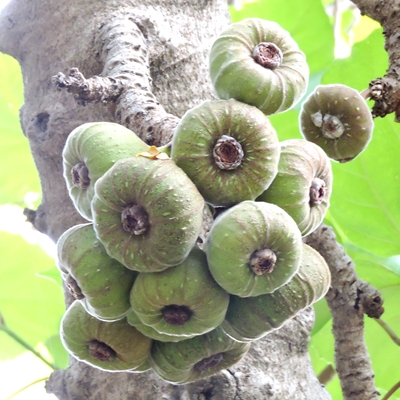
Syconia of the Roxburgh Fig (Ficus auriculata). Photography by Yael Orgad