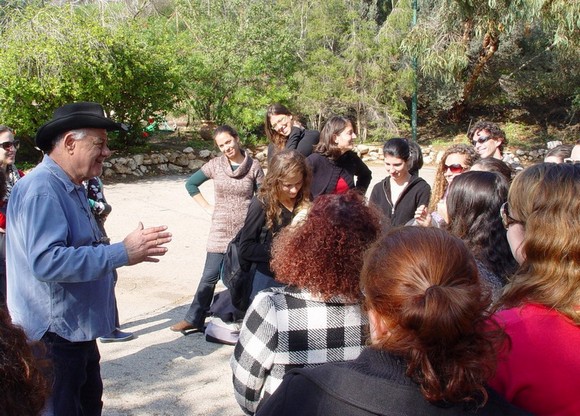
Prof. Jacob Garty

Director of the Botanic Garden, 2004–2009

Professor Jacob Garty served as the Director of the Botanic Garden from 2004 to 2009.
Jacob Garty was born in Beirut in 1938 and immigrated to Israel in 1943. He studied at the Mikveh Israel Agricultural School. From 1962 to 1965, he studied Agriculture at the Hebrew University of Jerusalem. He then moved to Tel Aviv University for his graduate studies under the supervision of Professor Margalith Galun. His Master’s thesis (1972) explored the ecology of lichens in the Sinai Peninsula, and his doctoral dissertation (1979) focused on lichens as bioindicators of air pollution.
Academic Career and Global Research
Following his PhD, Prof. Garty pursued postdoctoral research in the Department of Geomicrobiology at the University of Oldenburg, West Germany, and in biology at the McMurdo Research Station in Antarctica.
Upon returning to Israel, he served as a researcher in the Department of Botany and the Institute for Nature Conservation Research (INCR) at Tel Aviv University from 1980 to 1984. He was appointed Senior Lecturer in 1984 and received tenure in 1988. In 1993, he was promoted to Associate Professor, and in 2005, he was appointed Full Professor. He currently serves as Professor Emeritus.
Specialized Expertise
Prof. Garty is a world-renowned expert in lichenology (the study of lichens). His research significantly advanced our understanding of how these organisms respond to environmental stressors and air quality. Driven by this expertise, he established the Lichen Collection at the Botanic Garden – a unique living display that serves as both a vital taxonomic resource and a showcase for the environmental significance of these symbiotic organisms.
The Lichen Collection
Lichens are unique composite organisms composed of two distinct components: algae and fungi, living together in a symbiotic relationship (symbiosis). This specialized partnership grants lichens the resilience to survive in diverse habitats, including some of the most extreme environments on Earth, such as the polar regions and arid deserts. The lichens in the Garden’s collection were gathered from various regions across Israel and are displayed growing on different types of stone substrate.
In the collection, one can observe the three primary growth forms of the thallus (the vegetative body of the lichen):
- Crustose Lichens: These have a crust-like thallus that adheres tightly to the rock surface, forming a dense, carpet-like layer.
- Foliose Lichens: These are characterized by small, leaf-like lobes that branch out over the stone. This thallus is attached to the substrate only at specific points.
- Fruticose Lichens: Representing the most complex growth form, these are attached to the stone at a single point and extend outward in a three-dimensional, shrub-like structure.
Nature’s Air Quality Monitors
Due to their ability to efficiently absorb substances directly from the atmosphere, lichens serve as excellent bioindicators (biological detectors) for air pollution. For this reason, the Lichen Collection was strategically positioned within the Botanic Garden overlooking the bustling Ayalon Highway, allowing researchers to monitor the environmental impact of one of Israel's busiest traffic arteries.