
The New Anemone Map of Israel
A collaborative project brought to you by the Yehuda Naftali Botanic Garden, the Steinhardt Museum’s Israel Citizen Science Center, and the Society for the Protection of Nature in Israel.


The Poppy Anemone (Anemone coronaria) is the most beloved and common flower in Israel, growing from Mount Hermon in the north to the desert in the south. While anemones are widely regarded as red flowers, in various regions, one can find them in other colors – white, pink, purple, and even blue.
The new Anemone Survey, which includes hundreds of observations from across the country, reveals the geographical distribution and blooming periods of Israel's diverse anemones – corresponding to the amount of precipitation in these areas.

Map Legend:
-
Red dots: Populations of exclusively red anemones.
-
Light dots: Populations featuring red, white, and purple anemones.
Soil and Rain: The Science of Color
The survey reveals that multi-colored populations (red, purple, blue, and white) appear only in rainy areas with water-rich soil. These are Mediterranean regions where annual precipitation exceeds 450 mm (for example, in the north and center, down to the Judean Foothills).
In contrast, populations of exclusively red anemones are common in both Mediterranean regions and the drier, hotter parts of the country (such as the Negev), in calcareous soils where the concentration of calcium carbonate (CaCO3) is higher than 15%. Project leaders explain that this is why only red anemones bloom during the Darom Adom Festival.
Academic Background
The Anemone Survey began in 2019 as a citizen science project. Recently, the initiators decided to update the "Anemone Map" for 2026; the new study was even published in the American Journal of Botany. The project is led by Prof. Yuval Sapir, Director of the Yehuda Naftali Botanic Garden and senior researcher at the School of Plant Sciences and Food Security, Tel Aviv University, and Prof. Tamar Keasar of the Department of Biology and Environment at the University of Haifa - Oranim, under the co-guidance of PhD student Tzlil Labin.
Prof. Sapir notes: "The survey findings indicate that flower colors are not just a result of pollinator preferences, but also an adaptation to environmental conditions. Red anemones are adapted to arid regions and dry calcareous soils, while other colors – pink, purple, and white – can grow in more humid areas. Public cooperation in the project led to the reporting of hundreds of observations from all over the country via a simple online form."
Flowering Timelines
As part of a follow-up study funded by the DFG (German Research Foundation) and in collaboration with the University of Haifa, 18 sites were selected along the gradual climatic gradient in Israel, from the Mediterranean area in the Lower Galilee to the arid area in the western Negev (Gaza Envelope). The study found that bloom timing also varies by color:
-
Non-red anemones: Bloom earlier in the season, usually in January and February.
-
Mixed populations: Red anemones bloom on average two weeks later than non-red ones, primarily in early spring (March-April).
-
Exclusively red populations: In dry areas, the blooming period occurs even later.
Prof. Sapir points out that these differences are linked to abiotic factors such as soil salinity, lime levels, and average temperature, which also influence pollinator activity. While bees and flies are the primary visitors in Mediterranean areas (visiting mostly white and purple anemones), the later-blooming red anemones in dry areas are synchronized with the emergence of Glaphyrid beetles, which are their primary pollinators.
A Call to the Public
The research team and the SPNI are calling on the public to continue reporting anemones across the country. The ongoing Anemone Survey aims to collect multi-year data to understand the impact of climate change and extreme weather events on blooming dynamics.
Dr. Nirit Lavie Alon, Citizen Science Coordinator at the SPNI and the Steinhardt Museum: "The data collected from the citizen science project serves as a foundation for understanding spatial genetic variation and the ecological and evolutionary processes that create and preserve the color diversity of Israel's anemones. The survey allows the public to join scientific research that reveals how flower colors reflect the delicate balance between climate, soil, and pollinators, contributing to the preservation of Israel's biodiversity."
-
Seen an anemone? Report here: https://katzr.net/c99285
-
Project Website: https://www.teva.org.il/citizen-science/3389
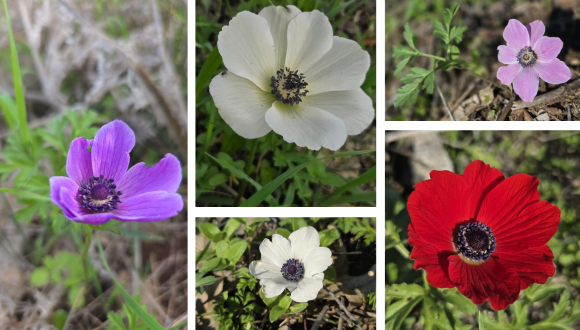
Poppy Anemone flowers (Anemone coronaria) in various color morphs. Purple and white anemones photographed in Megiddo; a red anemone photographed in Ramat Menashe. Photo: Yuval Sapir
Related Articles