
Bladderwort: The Delicate Predator of the Plant World
Tiny blooms above, high-speed vacuums below: meet the botanical garden's fastest hunter.


The Humped Bladderwort (Utricularia gibba), a member of the Bladderwort family (Lentibulariaceae), is currently flowering in the pond beneath the entrance bridge to the Tropical Greenhouse, nestled among the water lilies.
While it is a plant with small, delicate yellow flowers that peek just a few centimeters above the water’s surface to be pollinated by insects, the real drama unfolds underwater. Hidden there is one of the fastest hunting mechanisms in the plant kingdom.
A Free-Floating Aquatic Plant
The Humped Bladderwort is a submerged aquatic plant that floats freely and is not anchored to the bottom. It grows in standing or slow-moving bodies of water that are nutrient-poor (specifically lacking in available nitrogen).
The root-like parts of the shoot are called rhizoids. Generally, the plant lacks true roots; if they are present, they are very short-lived.
Leaves Transformed into Vacuum Traps
The Bladderwort has delicate green leaves, split into thin leaflets for photosynthesis. Some of these leaflets have undergone an extraordinary evolution, transforming into urricles—small, bladder-like sacs that function as traps for tiny aquatic prey (such as micro-crustaceans, aquatic insects, protozoa, or other minute organisms).
The trap operates using a vacuum suction technique:
-
The walls of the bladder pump water out, creating low pressure inside.
-
The trap opening is sealed by a one-way "trapdoor" that opens inward, surrounded by touch-sensitive hairs.
-
The moment a tiny prey touches these hairs, the stimulus causes the door to swing open, and the liquid—along with the prey—is sucked inside at incredible speed.
-
The door then snaps shut. This is one of the fastest responses in the plant world.
After closing, the plant digests the prey using enzymes secreted from the inner walls of the bladder, using the breakdown products to supplement its missing nutrients. Once digestion is complete, the bladders reset, ready to capture new prey.
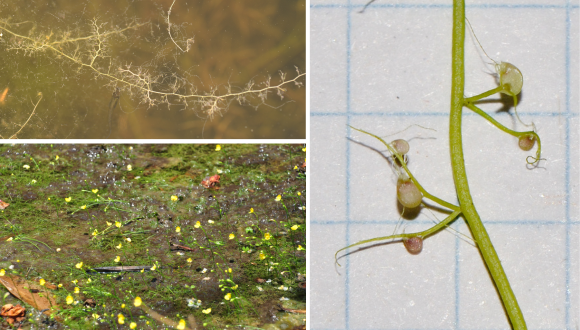
Top left: Capture bladders in the water. Bottom left: Flowering Humped Bladderwort. Photo credit: Gavri Sion. Right: Capture bladders of the Humped Bladderwort. Photo credit: Tanya Malchinsky.
The Humped Bladderwort: An Episodic Species in Israel
The Lentibulariaceae is a cosmopolitan family of insectivorous plants, comprising 4 genera and 245 species. The genus Utricularia (Bladderwort) includes 180 species with a worldwide distribution, but only two have ever been found in Israel.
The Common Bladderwort (Utricularia australis) went extinct in Israel in the 1940s. The Humped Bladderwort is considered an episodic species; it appears from time to time in various water sources only to disappear shortly after. It does not maintain stable populations in Israel over long periods.
The plants in the Garden were collected in the 1990s from the Gonen Meadows in the Hula Valley. While both species have a wide global distribution, they are on the brink of extinction in neighboring Mediterranean countries due to the drainage of wetlands and the destruction of these habitats.
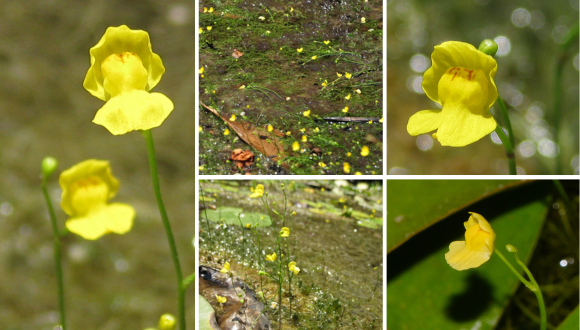
Humped Bladderwort. Photos by: Tanya Malchinsky, Gavri Sion, and Yuval Sapir.
Related Articles