The Birth of New Genes: How Evolution Invents from Scratch
A new ERC project by Dr. Idan Frumkin will explore how completely novel genes emerge and become functional, revealing a infrastructure of evolutionary innovation


"How fleeting are the wishes and efforts of man! How short his time! Consequently, how poor will his products be, compared with those accumulated by nature during whole geological periods. Can we wonder, then, that nature's productions should be far 'truer' in character than man's productions; that they should be infinitely better adapted to the most complex conditions of life, and should plainly bear the stamp of far higher workmanship?"
When Darwin wrote these words in On the Origin of Species, he was marveling at the creative power of evolution. Over a century and a half later, his observation remains strikingly relevant: even the most advanced AI models, trained on billions of data points and running on vast computational infrastructure, hold less functional complexity than a single living cell. What, then, enables this endless power of biological innovation?
A new prestigious ERC Starting Grant awarded to Dr. Idan Frumkin, a new principal investigator at the Shmunis School of Biomedicine and Cancer Research at Tel Aviv University, aims to reveal the mechanisms behind a key driver of genetic innovation in evolution: the birth of "orphan genes."
The Genes That Came from Nowhere
Hundreds of different genes in any genome across all branches of life, from bacteria to primates, are unique to that species or its close evolutionary lineage. These are orphan genes: genetic sequences with no recognizable relatives in other species. They are found everywhere, and in numbers. Recent surveys have identified over one million orphan genes in the genomes of gut bacteria alone. Yet most remain uncharacterized, their functions unknown, and the forces that govern their emergence poorly understood.
Where orphan genes have been studied, their roles often turn out to be remarkable. Some enable organisms to survive extreme cold. Others are involved in reproduction or in the proliferation of cancer cells. In microorganisms, orphan genes are major contributors to the genomic diversity that enables bacteria and viruses to adapt rapidly to new challenges, whether antibiotics, host immune systems, or environmental shifts.
"We're talking about a large fraction of every genome that essentially has no known origin story," explains Frumkin. "In bacteria and their viruses, where evolution runs fast and genomes are relatively compact, orphan genes are especially abundant, which makes these systems ideal for studying how new genes are born."
Two Routes to a New Gene
How does an entirely new gene come into being? Scientists have identified two main routes. The first involves the rapid and radical modification of an existing gene, a process so dramatic that the resulting sequence bears no recognizable resemblance to its ancestor. For all practical purposes, the connection between parent and offspring gene is erased.
The second route is more radical still: a stretch of DNA that previously had no coding function, a genomic "blank," begins to be read and translated into a protein. A non-functional sequence, through random changes, becomes a gene. This is de novo gene birth: creation from nothing.
Random Sequences, Real Functions
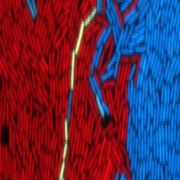
During his postdoctoral research, Frumkin provided direct experimental evidence that this second route is viable. He constructed a library of roughly 100 million short, completely random protein sequences and introduced them into millions of bacterial cells. Among these random sequences, with no evolutionary history and no design, he identified thousands that conferred real biological functions: some helped bacteria survive toxic conditions, others provided resistance to viral infection. "These random sequences effectively simulate the earliest stages of de novo gene birth," explains Frumkin. "They share similar biophysical properties with naturally occurring orphan proteins."
Now, with the ERC-funded Genovation project, Frumkin aims to understand the infrastructure that enables these randomly created and completely novel proteins to become functional and change the fate of the bacteria, for better or for worse.
Sorting Helpful, Harmless, and Harmful
Frumkin will begin by systematically measuring what happens when random protein sequences are expressed in living cells. By tracking the growth of millions of bacterial variants simultaneously, he will determine the fate of roughly 100,000 random sequences in the common lab bacterium E. coli. The goal is to sort these novel sequences into categories: the rare cases where a random protein benefits the cell, the majority that have no detectable effect, and those that harm or kill it.
This sorting will reveal what characterizes proteins that can persist without damaging the cell, a fundamental prerequisite for any new gene to survive long enough to become useful. But the harmful proteins are equally interesting. "In preliminary experiments, my students and I already found random sequences that completely shut down bacterial growth," says Frumkin. "We have reason to suspect that some of these don't just accumulate as junk in the cell and now hypothesize that they actively interfere with essential cellular processes, much like natural toxins do. If we can understand how a completely random protein manages to destabilize a bacterium, that's a potential starting point for a new class of antibiotics." And by comparing results across species, the project will distinguish innovation mechanisms that are universal from those specific to particular organisms.
Fitting into the Machine
For a novel protein to become truly functional, it cannot operate in isolation. It must work in coordination with the existing, highly complex molecular machinery of the cell. Frumkin's second line of research will examine what enables a completely new protein to be incorporated into established cellular systems.
By screening for new proteins that can immediately interact with basic biological mechanisms, fit into complex cellular apparatus, and change their function, this approach will reveal the principles enabling the development of novel biological functions and in which conditions could novel proteins become an active and significant part of a biological system.
Learning from Nature's Veterans
Finally, Frumkin will turn from synthetic random sequences to the real thing: the vast repertoire of orphan genes that nature has already produced in bacteriophages, the viruses that infect bacteria. Phages are the most abundant biological entities on Earth, and their genomes are rich with small, rapidly evolving genes that bear no resemblance to anything in known databases. "The random libraries tell us what's possible in principle," says Frumkin. "Phage orphan genes show us what evolution has actually selected and refined. By studying both, we can understand not just how new genes can be born, but what makes them successful."
These genes are the products of a relentless arms race: phages must constantly evolve new molecular tools to hijack bacterial cells, reprogram their metabolism, and overcome their defenses. By cloning representatives of phage genes and testing their effects on bacterial cells, and by using genetic tools to silence individual phage genes during infection, Frumkin will identify orphan genes that are critical for the virus to complete key stages of overtaking a cell: shutting down host defenses, redirecting the cell's resources toward viral replication, and manipulating fundamental processes like gene expression and metabolism. Understanding what makes these natural orphan genes successful will reveal the principles of functional genetic innovation as refined by billions of years of evolution.
Related Articles