
The Coastal sands, Kurkar & red Load hills Section

The Coastal sands, Kurkar & red Load hills section represents the flora of Israel's coastal plain.

The Tel-Aviv University Botanical Garden was established on a Kurkar hill, so the plant species you will find in this section are mostly local plants. Kurkar is a brittle sedimentary rock, created by an aggragation of sand and limestone. this is a semi-arid habitat, since the water are easily permeating through the porous rock. on such a rock there is an advantage for plants that are drought resistant, and in the Mediterranean climate zone in Israel's coastal plain you can find on the coastal sands and on the Kurkar hills a unique species combination - a cross point between Desert and Mediterranean flora.
The invasion of desert and Mediterranean flora to the geologically-young coastal plain caused the evolution of many plants into endemic species. over 30 plant species of the Coastal Plain grow only in Israel and its neighbours.
Having said that, Israel's Coastal Plain is also the most densely populated area in Israel, and due to the extensive development in the area, there is a significant damage to the Kurkar hills and their Flora. These are some of the most threatened habitats in Israel. As a result, many of the plants growing on these light soils are endangered species.
In this section you can see some of the plants growing on the first line of the shore, plants that can handle hard conditions such as salinity, aridity, soil movement (migrating sands). these condition are similar to some of the desert conditions, so there is a morphological similarity between the Coastal plants and the Desert plants.
Some unique plants you can see in this section are: the Coastal Iris (Iris atropurpurea), Topped Lavender (Lavandula stoechas) and Rothschild's Rumex (Rumex aeroplaniformis).
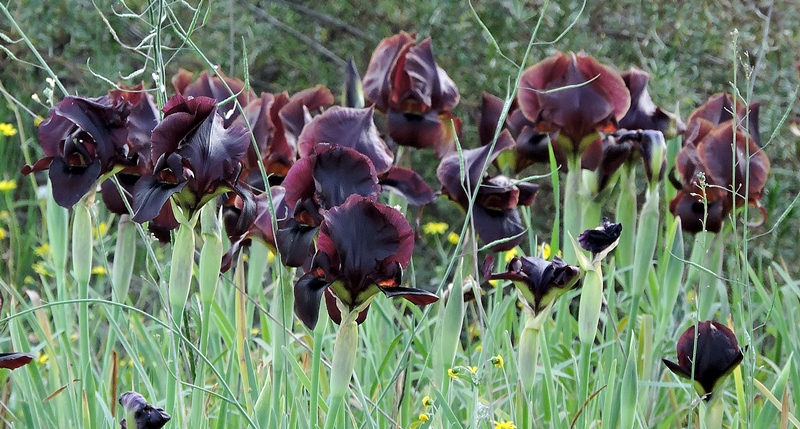
Coastl Iris (Iris atropurpurea) at the Kurkar hills section. | Picture by: Yael Orgad